
Citrus County Arrest Report Window
Start with the official multi-day source: the Citrus County Sheriff's Office Recent Arrest page. CCSO keeps arrest records there for the last ten days. A PDF link holds the active report. But that window only governs the web page. The file itself may lag. One recent edition covered August 24 through September 2, 2026. Check the printed dates before treating it as current. It earns the rolling-blotter label only then.
The report runs deeper than a same-day name list. Each entry shows why an event entered the system, plus an offense description and possible bond on each charge row. Arrest types vary. A felony or misdemeanor arrest, a Citrus County warrant, a warrant from another jurisdiction, a writ of bodily attachment, or a person borrowed for court can all appear. Those labels carry weight. They stop every entry from being misread as a fresh crime from that day.
The captured official CCSO landing page shows where the current county report is issued.

Watch the live page instead of a saved copy. CCSO replaces its current PDF link, and older files can carry an outdated date range.
Read Citrus County Arrest Reports
Read the reporting span first. Then trace each arrest number down to its charge rows. That order prevents two common mistakes: trusting a stale report as current and counting one person several times because several offenses appear.
- Open the CCSO Recent Arrest page and use its current PDF link.
- Read the starting and ending dates before searching for a name.
- Search by name or AR number, then compare the date and arrest type.
- Group every row bearing the same AR number before reading the charge set.
- Note whether the photo cell contains an image, is blank, or says None.
- Confirm custody with CoreCivic or Florida VINE and case outcome through the Citrus Clerk.
For a booking from the current day, follow the narrower Citrus County Arrested Today process. It uses the same official source. The focus is whether the file reaches today. The multi-day method instead rebuilds activity across the rolling period, making repeated AR numbers easier to interpret.
Citrus Arrest Report Entry Fields
The CCSO PDF is a charge table. It is not a narrative incident report. Release times, a custody flag, court dates, attorneys, and final dispositions do not reliably appear, and the actual columns carry narrower meanings.
| Field | What the entry shows |
|---|---|
| Photo | A booking image where available; a blank or None cell does not prove that no photo exists in the retained file. |
| AR # | The local arrest or report identifier, which may repeat when one event carries several charges. |
| Date | The arrest/report date entered by CCSO, not a guaranteed upload, release, or hearing date. |
| Arrest type | The event category, including arrests, warrants, writs, and court-borrow entries. |
| Offense | A statute or short description of the charge recorded at booking. |
| Name and DOB | Identity fields used to distinguish similar names. Full birth dates should not be republished casually. |
| Bond | An amount by charge row. It does not establish payment, release eligibility, or current custody. |
An AR number is not a Clerk case number or an FDC number. Keep that straight. For later court activity, search the Citrus Clerk's SCORSS docket, matching identity and event with care. SCORSS shows what the blotter cannot.
Citrus Weekend Posting Gaps
The sheriff's office publishes no set posting schedule. Nothing confirms weekend batches, per-shift refreshes, or a holiday pattern. So promising a Monday surge would mislead. What the official record does show is lag, since the linked report can trail the current date. A Chronicle account once described a jail booking log that had yet to appear on the sheriff page. When gaps like that hit, the Citrus County recent-arrest hub maps the wider official lookup paths.
Treat the PDF's latest date as the boundary. A weekend or holiday after it leaves the report silent. That silence says nothing about whether a booking occurred. CoreCivic runs the Citrus County Detention Facility and answers facility questions at (352) 527-3332. Florida VINE may show custody, release, or transfer for a covered person. Each answers a different question from the arrest log. And VINE itself can lag a fresh intake.
A longer date range helps spot delayed entries, but it never converts the CCSO report into a live jail roster.
Older Citrus Arrest Report Records
An item older than ten days leaves the CCSO web page. The file itself survives. Florida's GS2 retention schedule covers booking records and commitment/release lists, setting a floor of one anniversary year after release. A floor is not a destruction date. Agencies may hold material longer, and litigation, audit, case, or historical needs can extend retention.
For older official items, submit the CCSO public-records request form. Include the person's name, the date, the AR number when known, the arrest type, and the exact item sought. Jail records raise a custodian question. Ask whether CCSO or CoreCivic holds them. The form warns that staff work in the order received. Estimates, deposits, and up to 30 business days or longer are all possible. Questions go to (352) 341-7450.
Courts follow another path. The Citrus Clerk's SCORSS search shows filings and disposition after the arrest stage. Older material may live in the Clerk's microfilm. Newspaper and library archives sometimes keep published accounts too.
Citrus Arrest News Blotters
For narrative coverage of Citrus County arrests, one source stands out. The Citrus County Chronicle Crime & Courts section posts dated arrest digests. Some span two days. Selected crime and court stories run alongside. Older pieces note that arrest-report and mugshot details came from CCSO. Treat it as context. The paper is not the source of record.
A Chronicle story can stay online after the sheriff's rolling report changes. Some pieces sit behind access limits. For deeper history, look to archives. The University of Florida Digital Newspaper Library holds older issue scans. Citrus County Libraries offers in-house archive access to 1939. Read each archive with its publication date and source language intact. A news item may leave out a later dismissal or other outcome.
The Newscaster arrest digest shows yet another unofficial transcription layer.
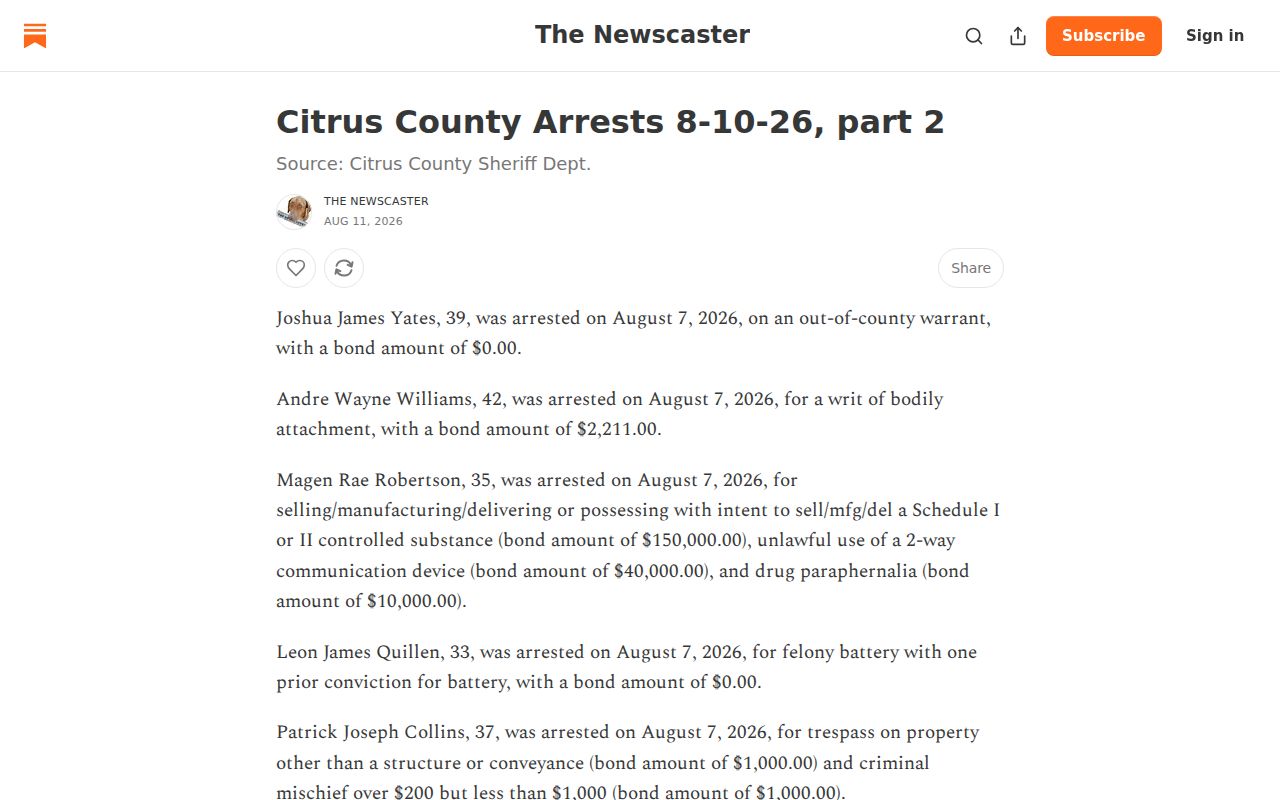
Digests can be incomplete or stale. Verify each listed event against CCSO and the court docket before relying on it.
Citrus Arrest Trends Need Context
A ten-day charge report cannot establish a crime trend. One AR number can fill several lines. The mix also includes warrants, writs, and court-related entries, not just new felony and misdemeanor arrests. Counting rows as people inflates the total. Publication delay can shift events between apparent periods.
For measured county-level patterns, the FDLE Criminal Justice Data Transparency arrest reports offer filters and export tools built on participating-agency transmissions. FDLE describes the adult and treat-as-adult data as not necessarily comprehensive. The dashboard is a statistical layer. It is not a photo blotter or person lookup.
Use its time filters for aggregate analysis. For an individual arrest record, return to CCSO or the Clerk.
Citrus Arrest Allegations and Outcomes
A booking entry records an arrest and an initial law-enforcement event. It is a snapshot. Charges can be amended, reduced, dismissed, or resolved after the PDF rolls off the sheriff page. The Fifth Judicial Circuit State Attorney publishes selected prosecution news. The Clerk docket supplies the case-specific path. Neither changes what the arrest report meant on its publication date.
Identity also deserves care. A matching name alone is weak evidence, especially with an old date range or a digest that omits key fields. Compare the AR number, date, arrest type, and lawful identity details. Then check the court record for the outcome. An archive preserves what was reported at the time.